Key facts
- A musty crawl space smell in Greenville, NC means mold or mildew is growing, and the odor comes from microbial volatile organic compounds (MVOCs).
- Mold can grow within 24–48 hours once relative humidity stays above 60%.
- The EPA data cited in this guide says up to 50% of first-floor air comes from the crawl space.
- Permanent odor removal combines a 20-mil vapor barrier, sealed vents and a commercial dehumidifier holding 45–55% RH.
- Crawl space mold remediation in Greenville costs $500–$10,000+ depending on how far the mold has spread, per W.J. Smith Construction.
- W.J. Smith Construction serves Greenville, Winterville, Farmville, Ayden, Bethel and the rest of Pitt County, NC; call 252-304-3012.
Last updated: October 2026
A musty crawl space smell in Greenville, NC means mold or mildew is actively growing; it is not just a nuisance; it is a health hazard. Greenville’s 80%+ summer humidity, 51 inches of annual rainfall, and Cecil clay soil create perfect conditions for moisture intrusion and mold growth. Up to 50% of your first-floor air comes from the crawl space (EPA data), so musty odors mean mold spores and microbial volatile organic compounds (MVOCs) are entering your living space. Permanent odor elimination requires removing the moisture source: encapsulation with a 20-mil vapor barrier, vent sealing, and a commercial dehumidifier maintaining 45–55% RH.
Why does my Greenville crawl space smell musty?
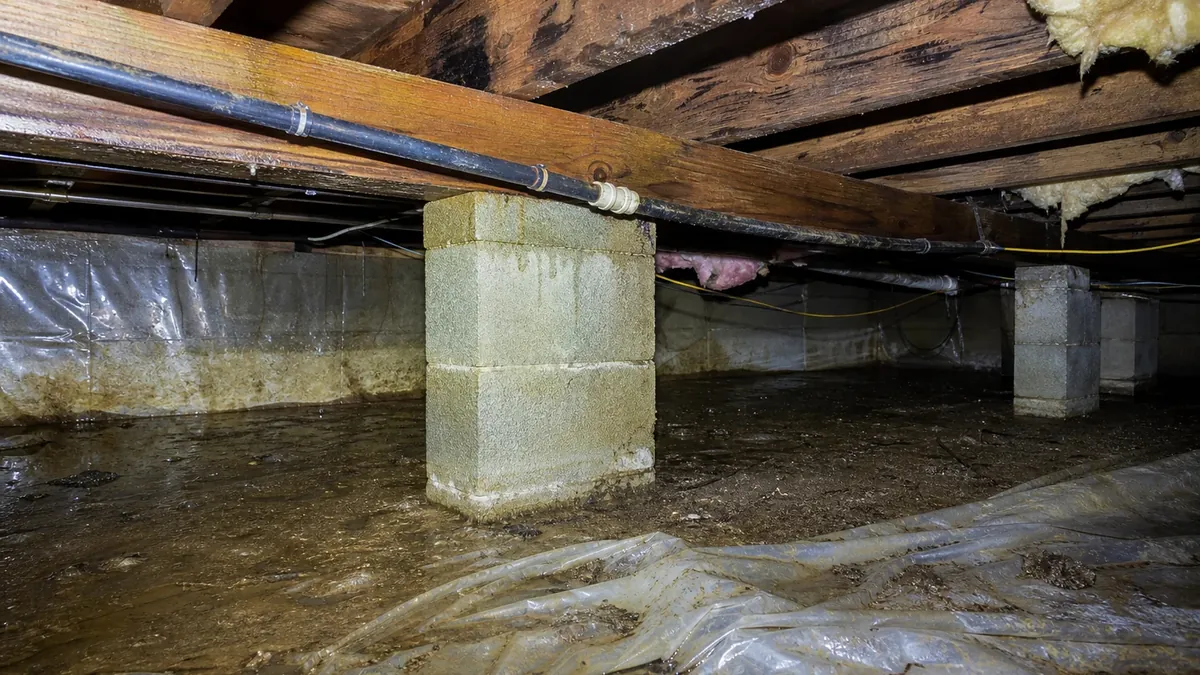
A musty crawl space smell is mold or mildew growing from moisture intrusion; it is not just a nuisance; it is a health hazard. The odor comes from microbial volatile organic compounds (MVOCs) released by active mold colonies as they digest organic materials (wood joists, paper-faced insulation, dust). Greenville’s climate delivers three moisture sources simultaneously: (1) ground vapor rising through Cecil clay soil (high CEC = constant evaporation), (2) humid air entering through foundation vents (80%+ summer RH), and (3) rainwater infiltration from 51 inches annual rainfall and poor grading. When these combine, RH exceeds 60%, and mold grows within 24–48 hours.
The Musty Odor Breakdown
- MVOCs = musty smell. Produced by Aspergillus, Cladosporium, Penicillium, Stachybotrys (black mold)
- Source = active mold digesting wood, paper, dust, insulation facing
- Trigger = RH >60% for 48+ hours
- Health impact = allergies, asthma, respiratory irritation, immune suppression in sensitive individuals
Greenville-Specific Causes
- 80%+ summer humidity — Ambient air enters vents, condenses on cool surfaces
- 51 inches annual rainfall — Saturates Cecil clay, raises water table 2–4 ft below grade
- Cecil clay soil — High cation exchange capacity (15–25 meq/100g) holds and releases moisture continuously
- Vented crawl spaces — 1960s–1980s code required vents; modern building science shows they increase moisture
- Tar River floodplain — Zones AE/AO have elevated water tables and hydrostatic pressure
Does musty smell mean mold in my crawl space?
Yes, a musty crawl space smell almost always means active mold or mildew growth, not just moisture. Musty odors are MVOCs produced by actively metabolizing mold colonies. If you smell must, there is active growth — even if you cannot see it. Visible black/green spots on joists or insulation confirm it, but absence of visible mold does not mean absence of mold. Mold grows in insulation cavities, behind vapor barriers, inside ductwork, and on the underside of subflooring. If the smell is strong enough to detect in your living space, spore counts are already elevated.
Common Crawl Space Fungi in Eastern NC
| Mold Species | Color | Health Impact | Common Location |
|---|---|---|---|
| Aspergillus | Green/gray/black | Allergies, asthma, aspergillosis | Wood, insulation, dust |
| Cladosporium | Olive/brown/black | Allergies, asthma triggers | Wood, textiles, HVAC |
| Penicillium | Blue/green/white | Allergies, mycotoxins | Water-damaged materials |
| Stachybotrys (black mold) | Black/greenish-black | Mycotoxins, severe respiratory | Chronic wet wood, paper |
Health Impact: 50% of Your First-Floor Air Comes From Below
EPA studies confirm 40–50% of first-floor air originates from the crawl space via stack effect (warm air rises, drawing crawl space air up through floor penetrations). In Greenville homes with musty crawl spaces, this means:
Mold spores circulating in bedrooms and living areas
MVOCs causing persistent musty odor in living space
Elevated humidity increasing dust mite populations
Higher asthma/allergy rates in children and elderly
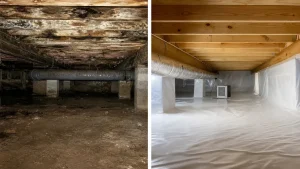
How to get rid of crawl space odor in NC humidity?
Permanent odor removal means eliminating the moisture source — not masking it with sprays, charcoal bags, or air fresheners. Seal the moisture source, dehumidify the air, clean the contamination. The only permanent solution for Greenville’s climate is full encapsulation with a commercial dehumidifier.
Crawl Space Odor Removal Solution Hierarchy
| Solution | Cost | Effectiveness | Permanence | Greenville Suitability |
|---|---|---|---|---|
| Air fresheners/sprays | $20–$100 | ❌ Masks only | Days | ❌ Never |
| Charcoal/moisture absorbers | $50–$200 | ❌ Symptom only | Weeks | ❌ Never |
| Retail dehumidifier alone | $200–$400 | Partial | 1–2 yrs (fails) | ❌ Insufficient |
| Vapor barrier (6-mil) only | $1,500–$3,000 | Partial | 2–5 yrs | ⚠️ Insufficient |
| Full encapsulation + dehumidifier | $5,000–$15,000 | ✅ Complete | 20+ years | ✅ Standard |
Step-by-Step Odor Removal Process
- Inspection — Digital moisture mapping, mold testing if needed, structural assessment
- Mold remediation — EPA-registered antimicrobial treatment, HEPA vacuuming, affected insulation removal
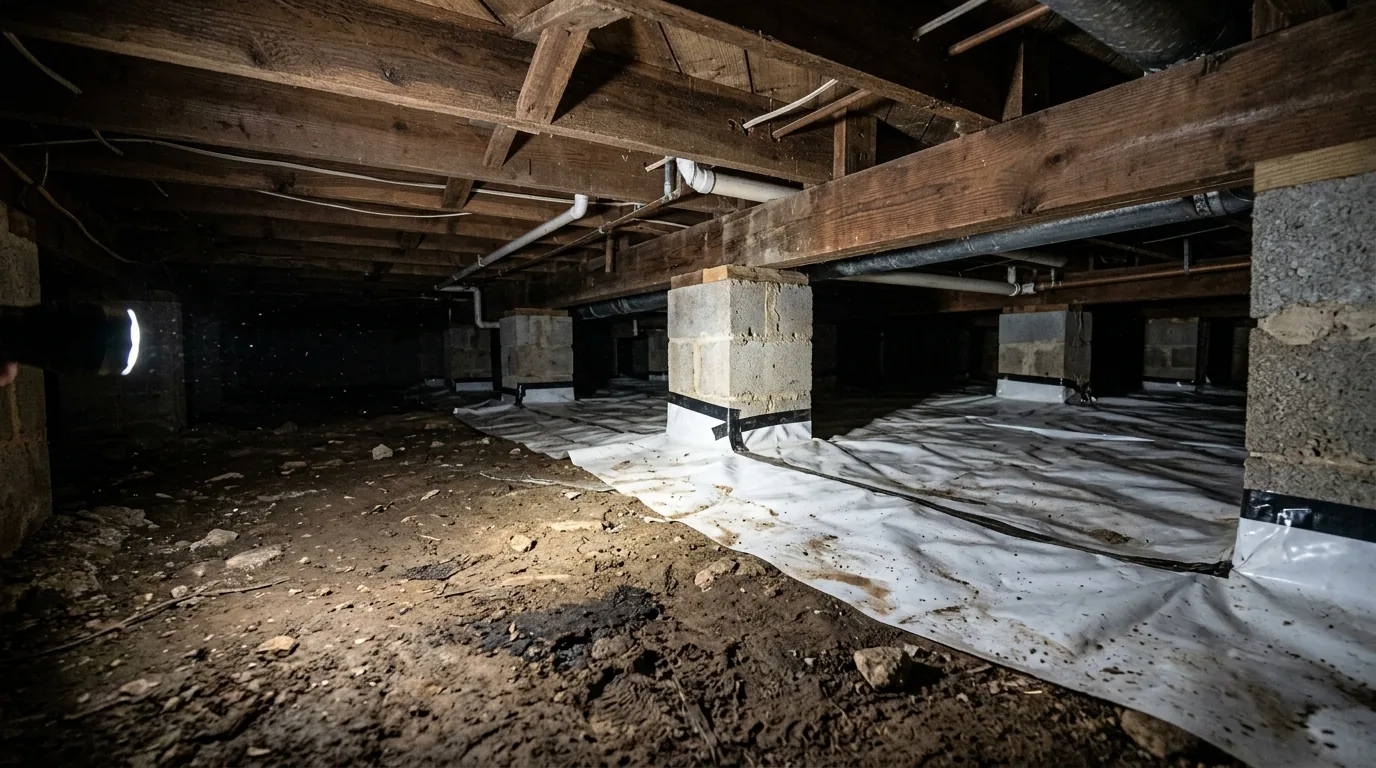
- Vapor barrier installation — 20-mil reinforced polyethylene on floor + walls, all seams taped
- Vent sealing — Rigid foam board + spray foam on all foundation vents
- Dehumidifier installation — Commercial-grade (Aprilaire/Santa Fe), 70–100 pint, condensate pump
- Air scrubbing — HEPA filtration during/after work to remove airborne spores
- Verification — Post-install RH monitoring at 45–55% target, 6-month follow-up
Will a vapor barrier stop crawl space smells?
Partially. A vapor barrier blocks ground moisture, reducing one of three moisture sources. But Greenville’s 80% humidity means airborne moisture still enters through vents, gaps, and porous foundation walls. A vapor barrier alone reduces odors but cannot maintain <60% RH year-round. Full encapsulation plus dehumidifier is required for permanent odor elimination.
Vapor Barrier Types for Odor Control
| Barrier Type | Ground Moisture Block | Air Moisture Block | Odor Reduction | Greenville Verdict |
|---|---|---|---|---|
| 6-mil polyethylene | 60% | 0% | 30–40% | ❌ Fails in 2–5 yrs |
| 10-mil reinforced | 75% | 0% | 40–50% | ⚠️ Better, not permanent |
| 20-mil encapsulated | 95% | 0% (needs dehumidifier) | 90%+ with dehumidifier | ✅ Standard |
Do I need encapsulation or just a dehumidifier for odors?
For permanent odor elimination in Greenville, full encapsulation plus a commercial dehumidifier is required. A dehumidifier alone treats the symptom (airborne moisture) but not the cause (ground moisture + vented humid air). Without encapsulation, a dehumidifier in a Greenville crawl space runs 24/7, burns $150–$300/year extra electricity, and fails to maintain <60% RH during peak summer. Encapsulation reduces the moisture load by 80–90%, allowing a properly sized dehumidifier to maintain 45–55% RH for $50–$120/year.
Encapsulation vs Dehumidifier-Only for Odor Control
| Feature | Dehumidifier Only | Full Encapsulation + Dehumidifier | Greenville Verdict |
|---|---|---|---|
| Blocks ground moisture | ❌ | ✅ | Full encapsulation |
| Blocks vented humid air | ❌ | ✅ | Full encapsulation |
| Maintains 45–55% RH | ❌ (fails summer) | ✅ Year-round | Full encapsulation |
| Annual energy cost | $150–$300 | $50–$120 | Full encapsulation |
| Equipment lifespan | 1–2 years (retail) | 5–10 years (commercial) | Full encapsulation |
| Mold prevention | Partial | Complete | Full encapsulation |
What causes crawl space mold in Pitt County homes?
Crawl space mold in Pitt County is caused by moisture intrusion + organic food sources + 80%+ summer humidity + poor ventilation. The “mold triangle” requires all three: (1) moisture source (ground vapor, rainwater, humid air), (2) food source (wood joists, paper-faced insulation, dust, cardboard), (3) time (24–48 hours at >60% RH). Greenville’s climate provides moisture continuously; the only controllable variable is the crawl space environment.
The Mold Triangle: Moisture + Food + Time
Moisture Source (RH >60%)
    ↓
Organic Food Source (wood, paper, dust)
    ↓
24–48 Hours
    ↓
MOLD GROWTH → MVOCs → MUSTY SMELL → SPORES IN LIVING SPACE
Greenville Mold Hotspots
- Homes near Tar River — Elevated water table, hydrostatic pressure, flood risk
- ECU-area rentals — 1960s–1980s builds, vented crawl spaces, deferred maintenance
- 1960s–1980s homes with vented crawl spaces — Original code required vents; modern science says seal them
- Homes with poor grading — Negative slope toward foundation, gutter discharge at foundation
- Homes with plumbing leaks — Even small leaks sustain mold in 80% humidity
How much does crawl space mold remediation cost in Greenville?
Crawl space mold remediation in Greenville costs $500–$10,000+ depending on extent. Minor surface mold (small area, non-structural): $500–$2,000. Extensive mold (structural wood, large area, insulation replacement): $2,000–$10,000+. Prevention through encapsulation ($5,000–$15,000) costs less than remediation and includes 25-year warranty.
Mold Remediation Cost Table
| Scope | Price Range | Timeline | Includes | Greenville Notes |
|---|---|---|---|---|
| Minor surface mold | $500–$2,000 | 1 day | Antimicrobial, HEPA vac, disposal | Surface only, non-structural |
| Moderate (joists, subfloor) | $2,000–$5,000 | 1–2 days | + Wood treatment, insulation replace | Common in 1970s ECU homes |
| Extensive (structural) | $5,000–$10,000+ | 2–4 days | + Structural repair, full cleanup | Requires engineer eval |
| Prevention (encapsulation) | $5,000–$15,000 | 2–3 days | Barrier, dehumidifier, 25yr warranty | Costs less than remediation |
Can crawl space smells affect my home’s air quality?
Yes — up to 50% of your first-floor air comes from the crawl space. Musty odors mean mold spores and VOCs are entering your living space, triggering allergies, asthma, and respiratory issues. Children, elderly, and immunocompromised individuals are most affected. Greenville’s ECU student rental market sees this frequently: tenants report allergies/asthma that resolve after encapsulation.
Indoor Air Quality Impact Table
| Pollutant | Source | Health Impact | Concentration in Musty Crawl Space |
|---|---|---|---|
| Mold spores | Active growth | Allergies, asthma, infections | 10,000–1,000,000 spores/m³ |
| MVOCs | Mold metabolism | Odor, irritation, headaches | Detectable at ppb levels |
| Mycotoxins | Stachybotrys, others | Immune suppression, neurotoxic | Present in black mold |
| Dust mites | High humidity | Allergies, asthma | 100–500 mites/g dust |
| Radon | Soil gas | Lung cancer (2nd leading cause) | Unrelated to odor but same pathway |
How long does odor removal take after encapsulation?
Encapsulation itself takes 2–3 days. Odors reduce within 24–48 hours after dehumidifier activation as RH drops below 60% and mold goes dormant. Full air quality restoration (spore counts normalized, MVOCs dissipated) takes 1–2 weeks. W.J. Smith includes post-install HEPA air scrubbing and 6-month follow-up verification.
Timeline to Fresh Air
| Timeframe | RH Level | Odor | Air Quality |
|---|---|---|---|
| Pre-install | 70–85% | Strong musty | High spores, MVOCs |
| Day 1 (install) | 65–75% | Strong | Active remediation |
| Day 2–3 | 55–65% | Noticeable reduction | Spores settling |
| Day 4–7 | 50–55% | Minimal | Significant improvement |
| Day 14 | 45–55% | Gone | Normal indoor levels |
| 6 months | 45–55% | None | Stable, verified |
Crawl space smells that are not mold
Not every crawl space odor is mold. A sewer-like or rotten-egg smell can point to a plumbing or drain problem rather than MVOCs, and a brief damp-earth smell after heavy rain can come from wet soil without active mold growth. A smell that stays, returns every humid summer, or spreads into the rooms above is the pattern that points to mold and moisture, and that is when an inspection is worth booking.
Related reading: crawl space encapsulation in Greenville NC removes the moisture source behind the smell, encapsulation vs vapor barrier explains why a barrier alone often falls short, and sump pump installation handles standing water.
What areas near Greenville do you treat for crawl space odors?
We treat crawl space odors in Greenville, Winterville, Farmville, Ayden, Bethel, and all of Pitt County plus Eastern NC. Free inspections within 2 hours of Greenville.
Our Crawl Space Odor Removal Process in Greenville, NC
Firstly, we conduct a free 60–90 minute inspection with moisture mapping, mold assessment, and structural evaluation. Secondly, we provide a written report within 48 hours with findings, remediation plan, transparent pricing, and financing options. Thirdly, we perform mold remediation using EPA-registered antimicrobials, HEPA vacuuming, and contaminated material removal. Fourthly, we install full encapsulation: 20-mil reinforced barrier on floor and walls, all vents and penetrations sealed. Fifthly, we install a commercial dehumidifier (Aprilaire/Santa Fe) with condensate pump and remote monitoring. Finally, we verify RH at 45–55%, provide warranty documentation, and schedule 6-month follow-up.
Why Choose W.J. Smith Construction for Crawl Space Odor Removal in Greenville?
- Local family-owned — Not a franchise. Willie Smith lives in Greenville.
- Licensed NC General Contractor — Permits, code compliance, insurance.
- Free 48-hour written report — Photos, moisture readings, clear pricing.
- Transparent pricing online — No sales pressure, no “today only” games.
- 20-mil barrier standard — Not an upsell. 6-mil fails in NC clay.
- Commercial dehumidifiers only — Aprilaire/Santa Fe. Retail units fail in 1–2 years.
- Transferable 25-year warranty — Increases resale value.
- 80 Google reviews, 4.9/5.0 — Verified local homeowners.
- BuildZoom score 104 — Top 9% of 101,103 NC contractors.
- Chamber of Commerce member — Vested in this community.
Frequently Asked Questions
Q: Why does my crawl space smell musty in Greenville?
A: Musty odors come from mold or mildew growing in your crawl space. Greenville’s 80%+ summer humidity, 51″ annual rainfall, and Piedmont clay soil create perfect conditions for moisture intrusion and mold growth.
Q: Does a musty smell always mean mold?
A: Almost always. Musty odors are microbial volatile organic compounds (MVOCs) produced by active mold colonies. If you smell must, there’s active growth — even if you can’t see it.
Q: Will a vapor barrier stop crawl space smells?
A: Partially. A vapor barrier blocks ground moisture, which reduces mold food. But Greenville’s humidity means airborne moisture still enters. Full encapsulation plus dehumidifier is required for permanent odor elimination.
Q: How much does mold remediation cost in Greenville?
A: Minor mold (small area, surface only): $500–$2,000. Extensive mold (structural wood, large area): $2,000–$10,000+. Prevention through encapsulation costs less than remediation.
Q: Can crawl space smells affect my health?
A: Yes. Up to 50% of your first-floor air comes from the crawl space. Musty odors indicate mold spores and VOCs entering your living space, which can trigger allergies, asthma, and respiratory issues.
Q: How long does odor removal take?
A: Encapsulation takes 2–3 days. Odors reduce within 24–48 hours after dehumidifier activation. Full air quality restoration takes 1–2 weeks.
Q: Do I need encapsulation or just a dehumidifier?
A: For permanent odor elimination, full encapsulation plus dehumidifier is required. A dehumidifier alone treats the symptom; encapsulation eliminates the moisture source.
Q: What causes crawl space mold in Pitt County?
A: Moisture intrusion + organic materials (wood/insulation) + 80%+ humidity. Common in homes near Tar River, ECU-area rentals, 1960s–1980s homes with vented crawl spaces.
Q: Will insurance cover mold remediation?
A: Sometimes — if mold results from a covered sudden event (burst pipe, flood). Gradual moisture intrusion is typically not covered. W.J. Smith can help document for claims.
Q: What areas near Greenville do you service?
A: We treat crawl space odors in Greenville, Winterville, Farmville, Ayden, Bethel, and all of Pitt County plus Eastern NC. Free inspections within 2 hours of Greenville.
Ready to Eliminate That Musty Crawl Space Smell Permanently?
Call 252-304-3012 or Email admin@wjsmithconstruction.com
Free inspection • Written report in 48 hours • Transparent pricing • 25-year transferable warranty