Key facts
- For Greenville, NC homes, full encapsulation with a commercial dehumidifier is the standard W.J. Smith Construction recommends over a vapor barrier alone.
- A vapor barrier covers the crawl space floor only, while encapsulation also covers the walls and seals vents and gaps.
- W.J. Smith Construction prices a 6-mil vapor barrier at $1,500–$3,000, a 10-mil barrier at $2,500–$5,000, and 20-mil full encapsulation with dehumidifier at $5,000–$12,000.
- Greenville gets about 51 inches of rain a year with 80%+ summer humidity, so airborne moisture matters as much as ground moisture.
- Homes in the Tar River floodplain (zones AE/AO) are advised to add a battery backup sump pump.
- W.J. Smith Construction serves Greenville, Winterville, Farmville, Ayden, Bethel and the rest of Pitt County, NC; call 252-304-3012.
Last updated: October 2026
For Greenville, NC homes, full encapsulation with a commercial dehumidifier is the gold standard — not a budget vapor barrier alone. Greenville’s 51 inches of annual rainfall, 80%+ summer humidity, and Cecil clay soil create a three-pronged moisture attack: ground vapor rises through the soil, humid air enters through vents, and clay holds moisture against foundation walls. A 6-mil vapor barrier covers only the floor and fails in 2–5 years. Adding a dehumidifier without sealing vents treats the symptom, not the cause. Full encapsulation — 20-mil reinforced polyethylene on floor and walls, all vents and gaps sealed, plus a commercial dehumidifier — is the only system that maintains 45–55% RH year-round in Eastern NC.
What’s the difference between crawl space encapsulation and vapor barrier in NC?
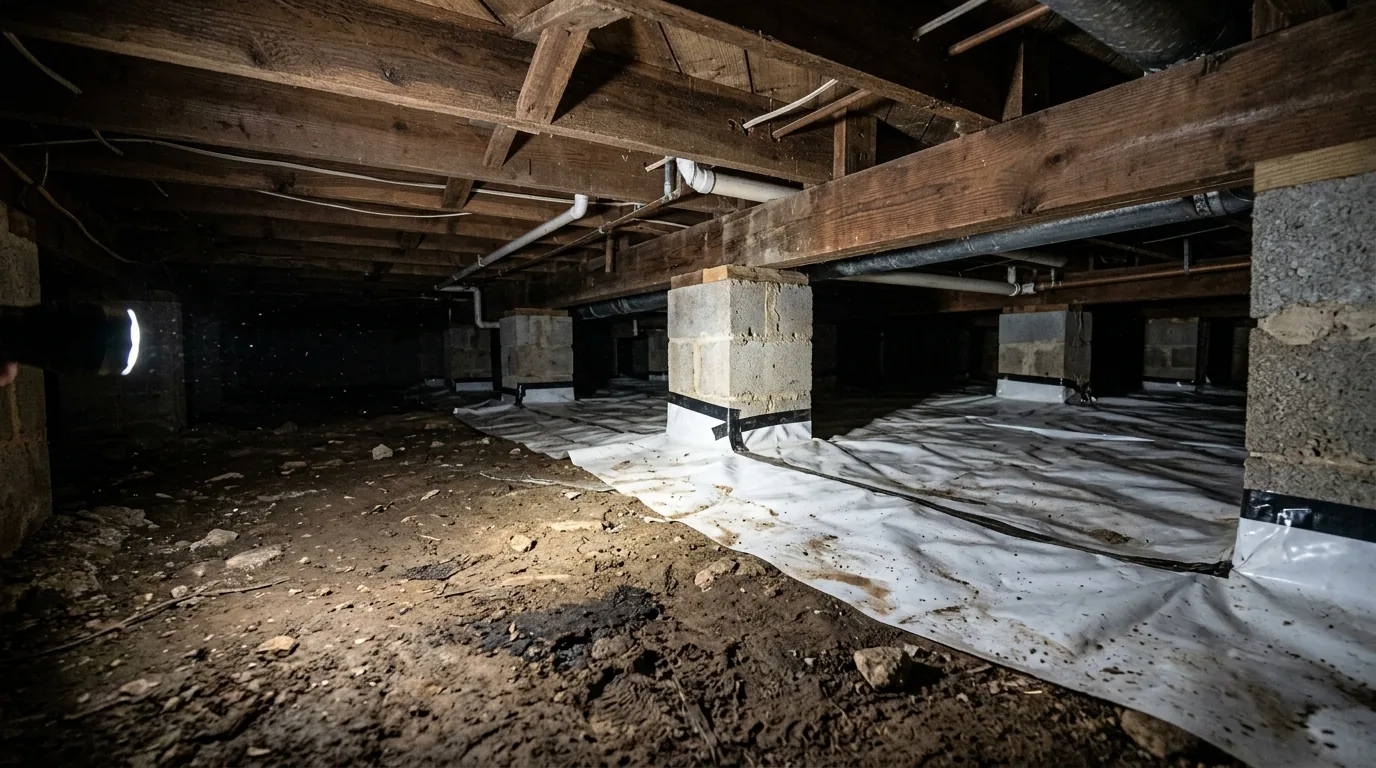
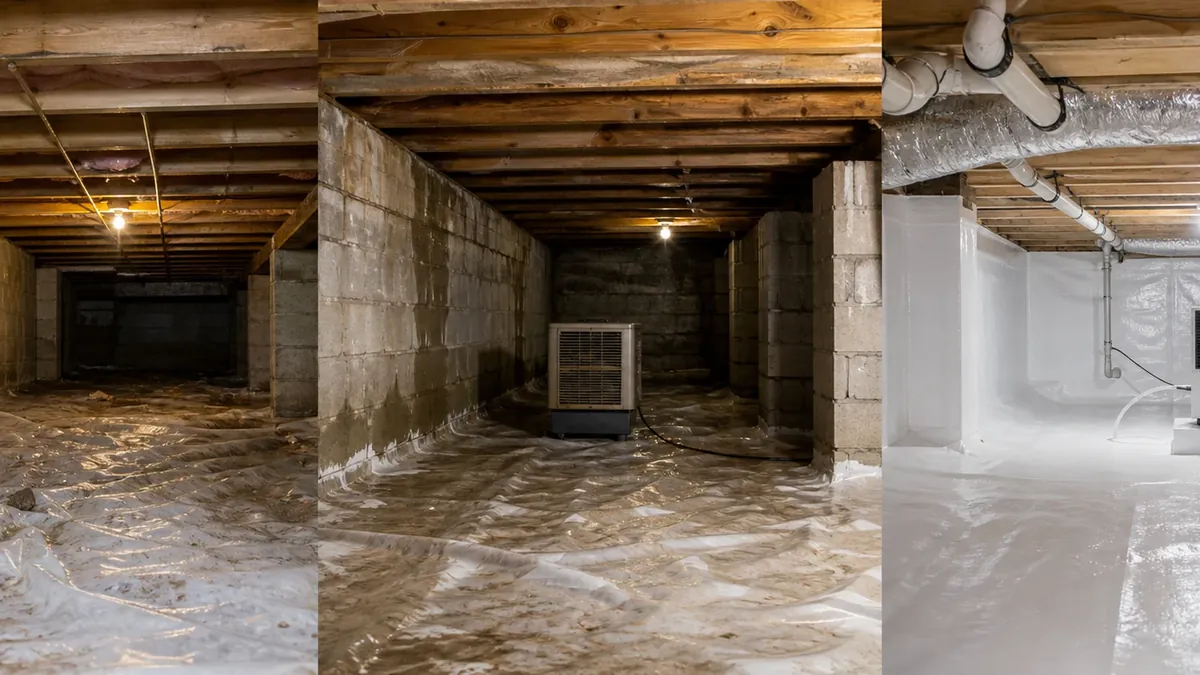
A vapor barrier is a plastic sheet (typically 6-mil or 10-mil) laid over the crawl space floor only. It blocks ground moisture but does nothing for humid air entering through vents, gaps around pipes, or porous foundation walls. Encapsulation is a complete system: 20-mil reinforced polyethylene covers the floor AND walls up to the sill plate, all vents and utility penetrations are sealed with foam and tape, and a commercial dehumidifier maintains 45–55% RH. In Greenville’s climate, the difference is not academic — it is the difference between a dry, mold-free crawl space and one that grows mold within 48 hours of summer humidity spikes.
Vapor Barrier Only: The $1,500–$4,000 Solution
- What it does: Covers the dirt floor with 6-mil or 10-mil polyethylene, reducing ground moisture evaporation into the crawl space air
- What it doesn’t do: Does not seal vents, does not cover walls, does not control airborne humidity, does not include a dehumidifier
- Lifespan in NC clay: 6-mil tears in 2–5 years from soil movement and foot traffic; 10-mil lasts 8–12 years
- Best for: New construction with proper grading and drainage, slab homes, budget-constrained situations where any protection is better than none
- Greenville limitation: Summer RH still hits 70–80% because vents remain open and walls are uncovered
Full Encapsulation: The $5,000–$15,000 Solution
- What it includes: 20-mil reinforced polyethylene on floor AND walls, all vents sealed, utility penetrations sealed, commercial dehumidifier installed, remote humidity monitor included
- What it achieves: 45–55% RH year-round, mold prevention, 15–25% HVAC energy savings, structural protection, improved indoor air quality
- Lifespan in NC clay: 20+ years for 20-mil barrier; dehumidifier 5–10 years with maintenance
- Best for: Most Greenville homes, especially 1960s–1980s homes near ECU, Tar River floodplain properties, homes with existing moisture/mold issues
- W.J. Smith standard: 20-mil barrier included at no upcharge; commercial dehumidifier standard; 25-year barrier / 10-year labor warranty transferable
Solution Comparison Table
| Feature | Vapor Barrier Only (6-mil) | Vapor Barrier Only (10-mil) | + Dehumidifier Add-On | Full Encapsulation (20-mil) | Greenville Verdict |
|---|---|---|---|---|---|
| Blocks ground moisture | Partial | Good | Good | Complete | Full encapsulation |
| Blocks airborne humidity | ❌ | ❌ | ✅ | ✅ | Full encapsulation |
| Seals vents & gaps | ❌ | ❌ | ❌ | ✅ | Full encapsulation |
| Maintains <50% RH | ❌ | ❌ | ✅* | ✅ | Full encapsulation |
| Prevents mold growth | ❌ | ❌ | Partial | ✅ | Full encapsulation |
| Energy savings (HVAC) | None | None | 5–10% | 15–25% | Full encapsulation |
| Warranty | 10yr | 15yr | 5yr (dehumidifier) | 25yr barrier / 10yr labor | Full encapsulation |
| Transferable | ✅ | ✅ | ✅ | ✅ | All options |
| Cost | $1,500–$3,000 | $2,500–$5,000 | +$1,200–$2,500 | $5,000–$15,000 | Worth the investment |
*Dehumidifier alone without sealed vents runs constantly and fails in 1–2 years in NC humidity.
Do I need a dehumidifier if I encapsulate my crawl space in Greenville?
Yes. Encapsulation blocks ground moisture and seals vents, but Greenville’s 80%+ summer humidity means ambient air still carries moisture that diffuses through foundation walls, enters through microscopic gaps, and accumulates from daily activities (showers, cooking, breathing). A commercial dehumidifier maintains the EPA-recommended 45–55% RH — the threshold below which mold cannot grow. Without it, encapsulated crawl spaces in Eastern NC still hit 60–70% RH during July–September, which is enough for mold growth. The dehumidifier is not an add-on; it is the active component that makes encapsulation work in our climate.
Why Encapsulation Alone Isn’t Enough in NC
Greenville’s climate creates a “stack effect” where warm, humid air is drawn up from the crawl space into the living space. Even with vents sealed, concrete and block foundation walls are porous — they wick moisture from the surrounding Cecil clay soil. A 1,500 sq ft crawl space in Greenville can absorb 10–15 gallons of water vapor per day from the walls alone during summer. A commercial dehumidifier removes this moisture continuously. Without it, the encapsulated space becomes a sealed mold incubator within one summer season.
Dehumidifier Sizing for Greenville Crawl Spaces
| Crawl Space Size | Recommended Pint Capacity | Typical Model | Air Changes/Day | Best For |
|---|---|---|---|---|
| Under 1,000 sq ft | 70 pint | Aprilaire E070 | 4–6 | Small homes, additions |
| 1,000–2,000 sq ft | 90–95 pint | Aprilaire E100, Santa Fe Compact70 | 4–6 | Most Greenville homes |
| 2,000–3,000 sq ft | 100+ pint | Santa Fe Classic, Aprilaire E130 | 3–5 | Large homes, high water table |
| 3,000+ sq ft | Dual 95 pint | Two Aprilaire E100 units | 4–6 | Commercial, multi-family |
W.J. Smith installs Aprilaire and Santa Fe commercial-grade units only. Retail dehumidifiers (Home Depot, Lowe’s) are designed for intermittent residential use and fail within 1–2 years under continuous NC crawl space operation.
Vapor barrier only vs encapsulation — cost comparison for Pitt County homes?
W.J. Smith pricing: 6-mil vapor barrier $1,500–$3,000; 10-mil vapor barrier $2,500–$5,000; 20-mil full encapsulation with commercial dehumidifier $5,000–$12,000. National franchises like Tarheel Basement Systems charge $13,000–$20,000+ for equivalent systems because they include franchise fees, sales commissions, and mark up the 20-mil barrier as a “premium upgrade.” W.J. Smith is local, family-owned, and includes 20-mil as our standard. For a typical 1,500 sq ft Greenville crawl space, you pay $3,500–$6,000 less with us for better materials and a transferable warranty.
Cost Breakdown Table
| Solution | Price Range | Warranty | Lifespan | ROI Timeline | Best For |
|---|---|---|---|---|---|
| 6-mil vapor barrier | $1,500–$3,000 | 10yr | 2–5 yrs | Never (fails) | Budget only |
| 10-mil vapor barrier | $2,500–$5,000 | 15yr | 8–12 yrs | 10+ yrs | Mild moisture |
| 10-mil + dehumidifier | $3,700–$7,500 | 15yr/5yr | 8–12 yrs | 5–8 yrs | Moderate humidity |
| 20-mil full encapsulation | $5,000–$12,000 | 25yr/10yr | 20+ yrs | 3–5 yrs | Most Greenville homes |
| 20-mil + sump + dehumidifier | $6,500–$15,000 | 25yr/10yr/3yr | 20+ yrs | 3–5 yrs | Flood zone |
Financing Options for Pitt County Homeowners
Watercress Financial offers home improvement loans with terms up to 15 years, no prepayment penalties, and soft pull pre-qualification that won’t impact your credit score. Apply at credithub.watercressgroup.com. Minimum project $3,000. Typical monthly payment for a $10,000 encapsulation at 9.95% over 10 years: ~$130/month — less than the energy savings most homeowners see.
When is a vapor barrier enough for Eastern NC crawl spaces?
A vapor barrier alone is only enough for Greenville homes with: new construction (post-2010) with proper exterior drainage and grading, slab-on-grade foundations (no crawl space), crawl spaces that stay below 55% RH year-round without mechanical dehumidification (rare in Eastern NC), or budget situations where partial protection is better than none. For 95% of existing Greenville homes — especially those built before 2000 with vented crawl spaces, clay soil, and no exterior waterproofing — a vapor barrier alone fails to control humidity and mold within 2–5 years.
The 6-Mil, 10-Mil, 20-Mil Decision
| Mil Thickness | Material Cost/sq ft | Puncture Resistance | Lifespan in NC Clay | Greenville Recommendation |
|---|---|---|---|---|
| 6-mil | $0.15–$0.25 | Low | 2–5 years | Avoid — false economy |
| 10-mil | $0.30–$0.45 | Medium | 8–12 years | Acceptable for mild cases |
| 20-mil | $0.50–$0.75 | High | 20+ years | Standard for W.J. Smith |
The $200–$500 material upgrade from 10-mil to 20-mil saves $3,000–$8,000 in re-installation costs over 20 years. In Greenville’s active clay soil, 20-mil is not optional — it is the only thickness that survives seasonal soil movement.
What mil thickness vapor barrier for Greenville clay soil (6/10/20)?
20-mil reinforced polyethylene is the standard for Greenville — 6-mil fails in 2–5 years in Piedmont clay soil because Cecil clay expands and contracts 10–15% seasonally, tearing thin barriers at stress points. 10-mil lasts 8–12 years but still punctures from soil movement, foot traffic during maintenance, and root intrusion. 20-mil has a polyester reinforcement grid that distributes stress and resists puncture. W.J. Smith has zero 20-mil barrier failures in 20+ years of installations across Pitt County. The $300–$500 material upgrade pays for itself in the first re-installation you avoid.
Mil Thickness Comparison Table
| Mil | Thickness (mm) | Puncture Resistance (lbs) | Lifespan in NC Clay | Cost/sq ft | Greenville Verdict |
|---|---|---|---|---|---|
| 6-mil | 0.15 | 15–20 | 2–5 years | $0.15–$0.25 | ❌ Avoid |
| 10-mil | 0.25 | 25–35 | 8–12 years | $0.30–$0.45 | ⚠️ Minimum |
| 20-mil | 0.50 | 45–60 | 20+ years | $0.50–$0.75 | ✅ Standard |
Can I just install a dehumidifier without encapsulation in NC humidity?
A dehumidifier alone is a band-aid — without encapsulation, ground moisture continues to enter your crawl space through the dirt floor at a rate of 5–15 gallons per day per 1,000 sq ft in Greenville’s climate. The dehumidifier runs 24/7 trying to keep up, burning $150–$300/year in electricity, and still fails to maintain <60% RH during peak summer. Retail dehumidifiers fail in 12–18 months under this load. Commercial units last longer but are oversized for the space, short-cycling and wasting energy. The math is clear: encapsulation reduces the moisture load by 80–90%, allowing a properly sized dehumidifier to maintain 45–55% RH for $50–$120/year.
The Full System Approach
Barrier (blocks ground moisture) + Sealing (blocks air sealing (blocks exterior humid air) + dehumidifier (controls residual airborne moisture) = permanent solution. Remove any component and the system fails in Greenville’s climate. This is not a menu of options — it is a system where every component depends on the others.
Encapsulation vs vapor barrier vs dehumidifier — decision matrix for homeowners?
Use this decision matrix: Budget under $4,000 → 10-mil vapor barrier (temporary, plan to upgrade). Budget $5,000–$8,000 → full 20-mil encapsulation (permanent solution). Budget over $8,000 → full encapsulation + battery backup sump pump (flood zone protection). Home age: pre-1980 → encapsulation mandatory (no modern moisture protection). 1980–2000 → encapsulation strongly recommended. Post-2010 → evaluate existing drainage. Symptoms: musty smell, visible mold, sagging floors, high energy bills → encapsulation + dehumidifier. Flood zone AE/AO → encapsulation + dehumidifier + sump pump.
Decision Matrix Table
| Budget | Home Age | Symptoms | Flood Zone | Recommended Solution |
|---|---|---|---|---|
| Under $4k | Any | None (prevention) | X | 10-mil vapor barrier (plan upgrade) |
| $5k–$8k | Pre-1980 | Musty, mold, high bills | X | 20-mil encapsulation + dehumidifier |
| $5k–$8k | 1980–2000 | Minor moisture | X | 20-mil encapsulation + dehumidifier |
| $5k–$8k | Post-2010 | None | X | 10-mil + dehumidifier (evaluate) |
| Over $8k | Any | Active water intrusion | AE/AO | Encapsulation + dehumidifier + sump |
| Over $8k | Any | Structural concerns | X | Encapsulation + structural repair |
What does full encapsulation include that vapor barrier doesn’t?
Full encapsulation includes: 20-mil reinforced polyethylene on floor AND walls up to sill plate, all foundation vents sealed with foam board and spray foam, all utility penetrations (pipes, wires, ducts) sealed with foam and tape, commercial dehumidifier installed with condensate pump to exterior or sump, remote humidity monitor (view RH on your phone), and 25-year barrier / 10-year labor transferable warranty. A vapor barrier is just plastic on the floor. The difference is 40+ penetration seals, wall coverage, mechanical humidity control, and a warranty that transfers to the next homeowner — adding resale value.
What’s Included in W.J. Smith’s Encapsulation Package
- 20-mil reinforced polyethylene — Floor and walls to sill plate, all seams taped with 4-inch vapor tape
- Vent sealing — Rigid foam board cut to fit each vent, spray foam perimeter, vapor tape finish
- Penetration sealing — Every pipe, wire, duct, and conduit sealed with closed-cell foam and tape
- Commercial dehumidifier — Aprilaire or Santa Fe, 70–100 pint, with condensate pump
- Remote monitoring — WiFi hygrometer, alerts at 60% RH, viewable on smartphone
- Transferable warranty — 25 years barrier, 10 years labor, transfers to next owner
- Free annual inspection — First year included, optional maintenance plan after
How much more does encapsulation cost vs vapor barrier in Greenville?
Encapsulation costs $3,000–$11,000 more than vapor barrier alone, but pays back in 3–5 years via energy savings (15–25% HVAC = $300–$600/year), avoided mold remediation ($2,000–$10,000+), and home value increase (3–5% = $6,000–$15,000 on a $300,000 home). Over 20 years, a vapor barrier requires 2–4 re-installations ($6,000–$20,000 cumulative) while 20-mil encapsulation installs once. The “cheaper” option costs more long-term.
ROI Calculation for Greenville Homeowners
| Solution | Initial Cost | Annual Energy Savings | Mold Risk | Re-installs in 20 yrs | 20-Year Total Cost |
|---|---|---|---|---|---|
| 6-mil vapor barrier | $2,500 | $0 | High | 4–5 | $12,500–$20,000 + mold risk |
| 10-mil vapor barrier | $3,750 | $0 | Medium | 2 | $7,500 + mold risk |
| 20-mil encapsulation | $8,500 | $400–$600 | Low | 0 | $8,500 – $8,000 savings = ~$500 net |
Assumes 1,500 sq ft crawl space, average Greenville energy rates, 3% home value increase.
Which solution does W.J. Smith recommend for Tar River floodplain homes?
For Tar River floodplain homes (Zone AE/AO), we recommend full 20-mil encapsulation PLUS commercial dehumidifier PLUS battery backup sump pump. Zone AE/AO homes face elevated water tables 2–4 ft below grade, hydrostatic pressure against foundation walls, and power outages during hurricanes (Matthew 2016, Florence 2018, Ian 2022). The sump pump removes liquid water; the battery backup (8–24 hour runtime) keeps it running during outages; encapsulation + dehumidifier handles vapor. This three-layer system is required by many insurance carriers for flood zone coverage and meets Pitt County Building Inspections standards for substantial improvement.
Flood Zone Specific Recommendations
| Flood Zone | Minimum System | Recommended by W.J. Smith | Insurance Impact |
|---|---|---|---|
| Zone X (minimal risk) | Encapsulation + dehumidifier | Encapsulation + dehumidifier | Standard rates |
| Zone AE (100-year) | Encapsulation + dehumidifier + sump | Encapsulation + dehumidifier + battery backup sump | May require for coverage |
| Zone AO (shallow flooding) | Encapsulation + dehumidifier + sump | Encapsulation + dehumidifier + battery backup sump | Often required |
| Zone VE (coastal) | N/A (not in Pitt County) | N/A | N/A |
Pitt County Building Inspections requires permits for sump pump electrical and any structural modifications. W.J. Smith handles all permitting.
Our Crawl Space Assessment Process in Greenville, NC
Firstly, we schedule a free 60–90 minute on-site inspection at your convenience. Secondly, we measure crawl space dimensions, document existing conditions with photos, and test wood moisture content at 10+ points using a calibrated Delmhorst meter. Thirdly, we check foundation vents, grading, gutter discharge, and plumbing for leaks. Fourthly, we take RH and temperature readings in the crawl space and living space to calculate stack effect. Finally, we provide a written report within 48 hours with photos, moisture readings, recommended solution, transparent pricing, and financing options — no pressure, no sales pitch, just facts.
Why Choose W.J. Smith Construction for Crawl Space Solutions in Greenville?
- Local family-owned since 1990s — Not a franchise. Willie Smith lives in Greenville; his kids go to Pitt County schools.
- Licensed NC General Contractor — Pulls permits, meets code, carries liability insurance and workers’ comp.
- Free 48-hour written report — Photos, moisture readings, clear recommendations, fixed pricing — no surprises.
- Transparent pricing online — We publish our price ranges. No “call for quote” games.
- Battery backup sump standard — Included in every flood zone encapsulation; optional add-on elsewhere.
- 20-mil barrier standard — Not an upsell. Our minimum because 6-mil fails in NC clay.
- Commercial dehumidifiers only — Aprilaire/Santa Fe. No retail units that fail in 1–2 years.
- Transferable warranties — 25-year barrier, 10-year labor, 5-year dehumidifier — all transfer to next owner.
- 80 Google reviews, 4.9/5.0 — Verified local homeowners. BuildZoom score 104 (top 9% of NC contractors).
- Greenville-Pitt County Chamber of Commerce member — Vested in this community.
Frequently Asked Questions
Q: What’s the difference between encapsulation and vapor barrier?
A: A vapor barrier only covers the crawl space floor. Encapsulation seals the floor AND walls, seals all vents and gaps, and adds a commercial dehumidifier. It’s a complete moisture-control system for Greenville’s climate.
Q: Do I need a dehumidifier with encapsulation?
A: Yes. Encapsulation blocks ground moisture, but Greenville’s 80%+ summer humidity means airborne moisture still enters. A dehumidifier maintains 45–55% RH, the EPA-recommended safe zone.
Q: How much does encapsulation cost vs vapor barrier in Greenville?
A: Vapor barrier: $1,500–$4,000. Full encapsulation: $5,000–$15,000. W.J. Smith provides free inspections and transparent estimates. Financing available through Watercress Financial.
Q: When is a vapor barrier enough for Eastern NC homes?
A: Vapor barrier alone works for new construction with proper drainage, slab homes, or budget-constrained situations. For Greenville’s 51″ rainfall and clay soil, full encapsulation is the permanent solution.
Q: What mil thickness for Pitt County crawl spaces?
A: W.J. Smith recommends 20-mil reinforced polyethylene for Greenville homes. It lasts 20+ years in Piedmont clay soil. Six-mil barriers often fail in 2–5 years.
Q: Can I just use a dehumidifier without encapsulation?
A: No. A dehumidifier treats the symptom, not the cause. Without encapsulation, ground moisture continues to enter through the floor, and the dehumidifier will run constantly, increasing energy bills.
Q: How long does encapsulation take in Greenville?
A: Most encapsulations take 2–3 days. Structural repairs or mold remediation add 1–2 days. W.J. Smith provides a detailed timeline in your written proposal.
Q: Is encapsulation worth it for older Greenville homes?
A: Yes — especially for homes built 1960s–1980s near ECU campus or in Tar River floodplain areas. These homes often have minimal original crawl space protection and benefit most from encapsulation.
Q: Will encapsulation lower my energy bills?
A: Yes. Duke Energy NC data shows 15–25% HVAC savings after encapsulation in Eastern NC homes by reducing stack effect and humidity load on your air conditioner.
Q: What areas near Greenville do you service?
A: We serve Greenville, Winterville, Farmville, Ayden, Bethel, and all of Pitt County plus Eastern NC. Free inspections within 2 hours of Greenville.
Related reading: crawl space encapsulation in Greenville NC is the full service page, encapsulation cost in NC compares prices by city, and musty crawl space smell explains the symptom most homeowners notice first.
Ready to Choose the Right Crawl Space Solution for Your Greenville Home?
Call 252-304-3012 or Email admin@wjsmithconstruction.com
Free inspection • Written report in 48 hours • Transparent pricing • 25-year transferable warranty