Key facts
- Crawl space encapsulation is worth it for most Greenville, NC homes, according to W.J. Smith Construction.
- Complete encapsulation in Greenville costs $5,000–$15,000 depending on size, barrier thickness and dehumidifier needs.
- Most encapsulation jobs take 2–3 days, and a basic 20-mil barrier on a 1,500 sq ft crawl space takes 1–2 days.
- A commercial dehumidifier holds the crawl space at 45–55% RH, below the 60% level where mold grows.
- Greenville receives about 51 inches of rain a year with 80%+ summer humidity.
- W.J. Smith Construction serves Greenville, Winterville, Farmville, Ayden, Bethel and the rest of Pitt County, NC; call 252-304-3012.
Last updated: October 2026
Yes, crawl space encapsulation is worth it for most Greenville, NC homes. With 51 inches of annual rainfall, 80%+ summer humidity, and Cecil clay soil that traps moisture against your foundation, Greenville’s climate makes crawl space moisture intrusion not a question of if but when. Encapsulation pays back in 3–5 years through energy savings alone (15–25% on HVAC bills per Duke Energy NC data), plus it prevents mold growth, protects structural integrity, and increases home value by 3–5%. For homes near the Tar River floodplain or in ECU-area neighborhoods built in the 1960s–1980s, encapsulation is not optional, it is essential protection for your biggest investment.
How much does crawl space encapsulation cost in Greenville, NC?
Crawl space encapsulation in Greenville costs $5,000–$15,000 depending on crawl space size, vapor barrier thickness (6-mil vs 10-mil vs 20-mil), whether a commercial dehumidifier is included, and whether structural repairs or mold remediation are needed first. W.J. Smith Construction charges 20–30% less than national franchises like Tarheel Basement Systems ($13k–$20k+) because we are local, carry no franchise fees, and include 20-mil barrier as standard rather than an upsell. Most Greenville homes with 1,200–2,000 sq ft crawl spaces pay $6,000–$10,000 for complete encapsulation with dehumidifier. Free inspections and transparent written estimates within 48 hours.
Encapsulation Cost Breakdown by Component
| Component | Price Range | Warranty | Timeline | Best For | Greenville Notes |
|---|---|---|---|---|---|
| 6-mil vapor barrier | $1,500–$3,000 | 10yr | 1 day | Budget/new construction | Fails in 2–5 yrs in clay soil |
| 10-mil vapor barrier | $2,500–$5,000 | 15yr | 1–2 days | Mild moisture, good drainage | Better but not permanent |
| 20-mil full encapsulation | $5,000–$12,000 | 25yr barrier/10yr labor | 2–3 days | Most Greenville homes | Recommended for Pitt County |
| + Commercial dehumidifier | $1,200–$2,500 | 5yr | Same visit | All encapsulation jobs | Required in 80% humidity |
| + Battery backup sump | $800–$2,000 | 3yr | +4–8 hrs | Flood zone homes | Tar River floodplain essential |
| Mold remediation (if needed) | $500–$10,000 | 5yr | +1–2 days | Active mold growth | Prevention costs less |
What Affects the Cost in Pitt County?
Crawl space size — Larger spaces require more barrier material and labor ($3–$7 per sq ft)
Vapor barrier thickness — 20-mil costs 40% more than 6-mil but lasts 4x longer in Cecil clay
Dehumidifier inclusion — Commercial-grade units add $1,200–$2,500 but are mandatory for NC humidity
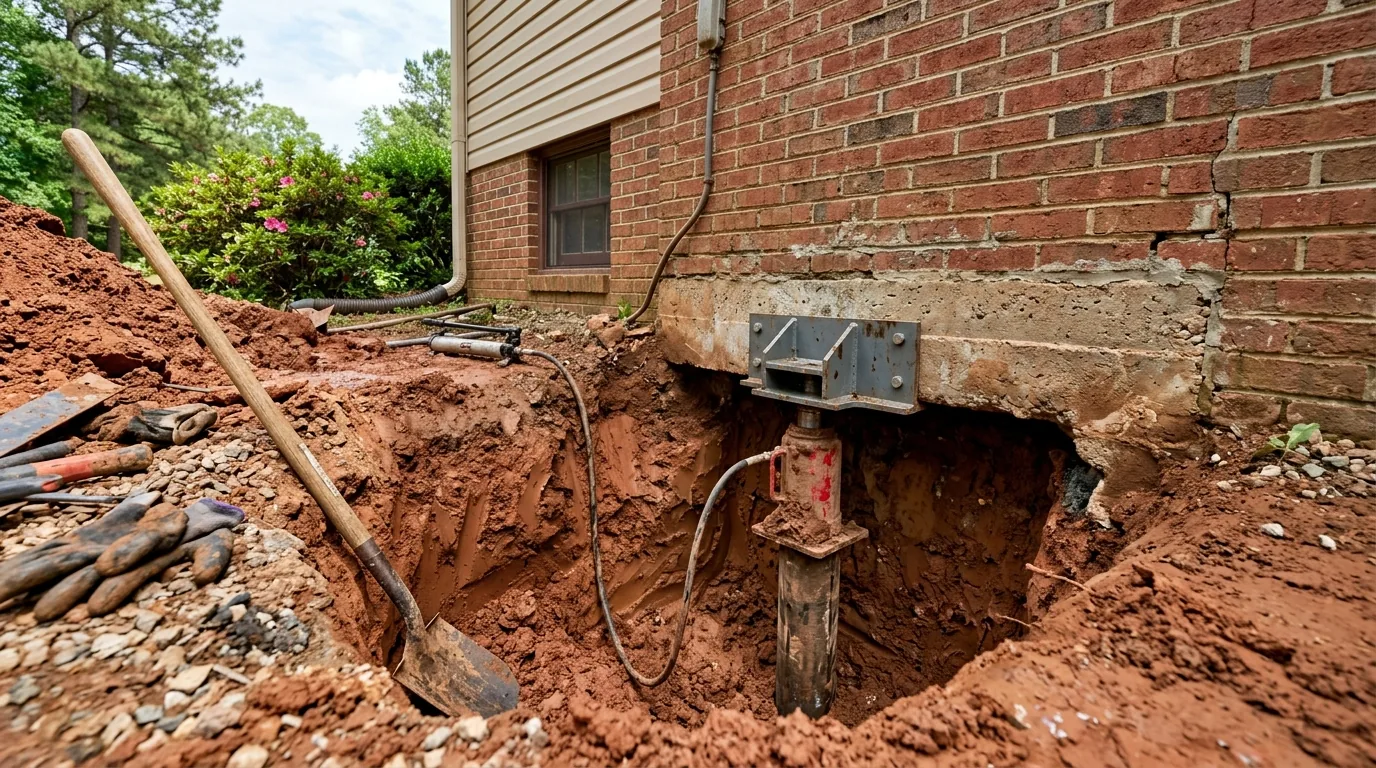
Structural repairs — Rotten joists or sagging floors add $2,000–$8,000
Mold remediation — Minor surface mold $500–$2,000; extensive structural mold $2,000–$10,000+
Permits — Pitt County Building Inspections may require permits for electrical (dehumidifier) and structural work
Access — Tight crawl spaces under 18 inches increase labor time 20–30%
Financing is available: terms up to 15 years, no prepayment penalties, soft pull pre-qualification that won’t impact your credit score.
What is crawl space encapsulation and why do Greenville homes need it?
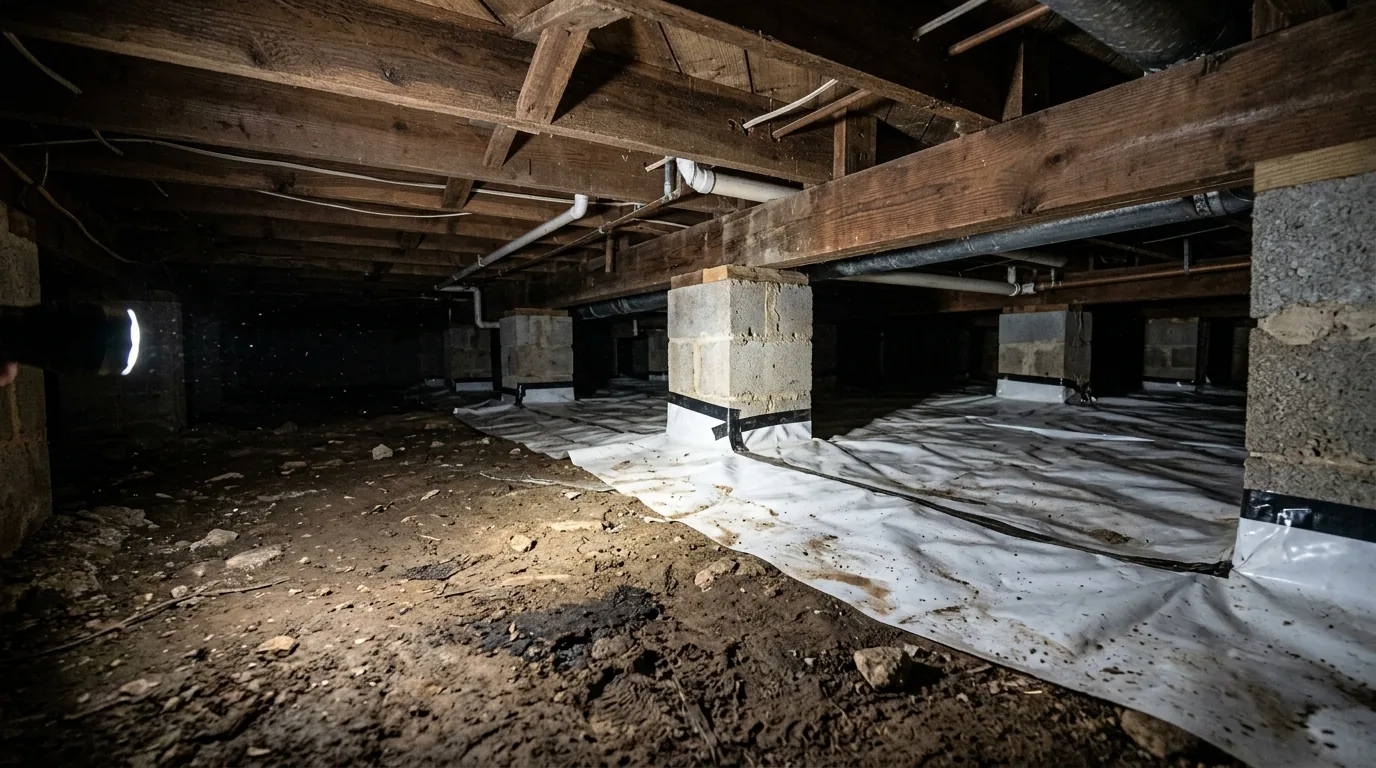
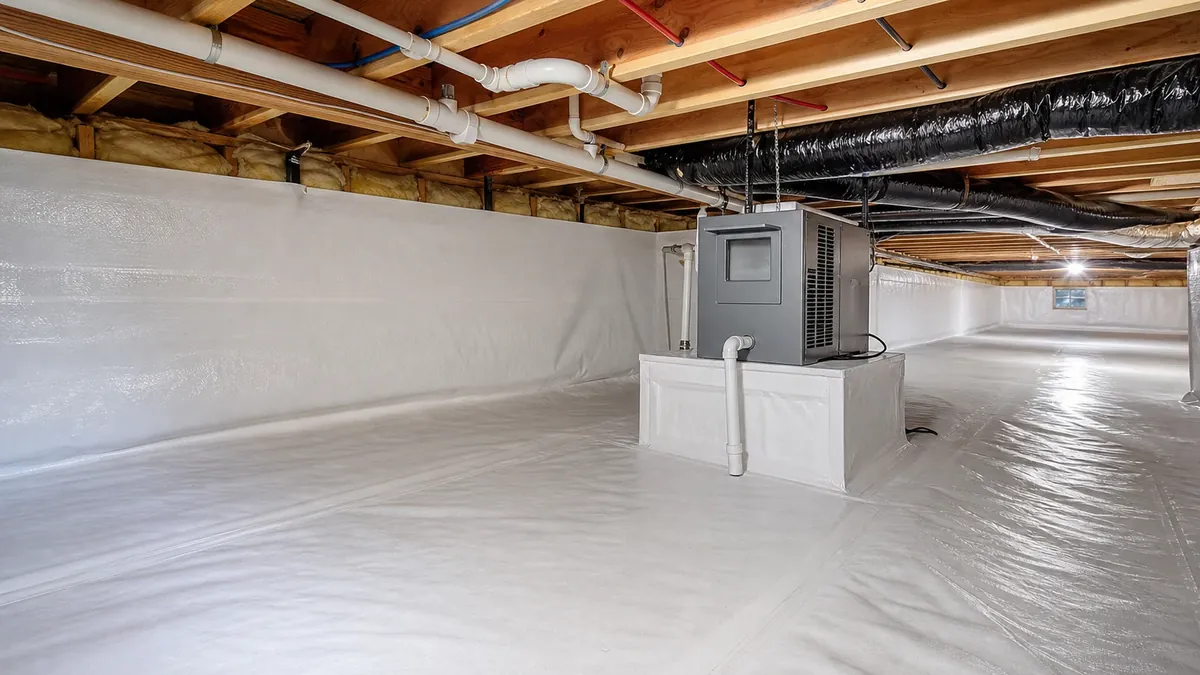
Crawl space encapsulation is a complete moisture control system that seals the crawl space floor with a reinforced vapor barrier, seals all vents and gaps against exterior humidity, and installs a commercial dehumidifier to maintain 45–55% relative humidity year-round. Unlike a simple vapor barrier that only covers the floor, encapsulation creates a conditioned space — effectively turning your crawl space into a mini-basement that stays dry, clean, and mold-free. Per NC State Extension data, Cecil clay soil (predominant in Pitt County) has a high CEC (15–25 meq/100g) meaning it holds and releases moisture continuously, making ground vapor the primary moisture source Greenville homes fight year-round.
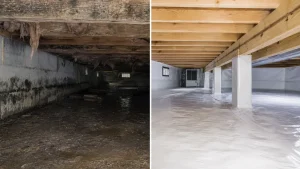
The Greenville Climate Reality
51 inches of annual rainfall — 20% above national average, saturating clay soil year-round
80%+ summer humidity — Ambient air carries moisture that enters through vented crawl spaces
Cecil clay soil — High CEC means constant ground moisture evaporation into crawl space
Tar River floodplain zones AE/AO — Homes in flood zones face elevated water tables 2–4 ft below surface
Duke Energy service area — HVAC systems run 6+ months/year, making energy efficiency critical
ECU-area housing stock — 1960s–1980s homes near campus often have vented crawl spaces with no moisture protection
Encapsulation vs Vapor Barrier vs Dehumidifier — Decision Matrix
| Feature | Vapor Barrier Only | + Dehumidifier | Full Encapsulation | Greenville Verdict |
|---|---|---|---|---|
| Blocks ground moisture | ✓ Partial | ✓ Partial | ✓ Complete | Full encapsulation |
| Blocks airborne humidity | ✗ | ✓ | ✓ | Full encapsulation |
| Seals vents & gaps | ✗ | ✗ | ✓ | Full encapsulation |
| Maintains <50% RH year-round | ✗ | ✓ | ✓ | Full encapsulation |
| Prevents mold growth | ✗ | ✓ | ✓ | Full encapsulation |
| Energy savings 15–25% | ✗ | Partial | ✓ | Full encapsulation |
| Transferable warranty | ✓ 10yr | ✓ 5yr | ✓ 25yr | Full encapsulation |
| Cost | $1,500–$4,000 | +$1,200–$2,500 | $5,000–$15,000 | Worth the investment |
Encapsulation vs vapor barrier vs dehumidifier
Vapor barrier in Greenville fails in 80%+ summer humidity because it only blocks ground moisture, not airborne humidity that enters through vents and gaps. Encapsulation plus a commercial dehumidifier is the gold standard for Greenville homes because it addresses all three moisture sources: ground vapor (barrier), exterior air (vent sealing), and airborne humidity (dehumidifier). A dehumidifier alone without encapsulation is a band-aid. It runs constantly trying to dry air that keeps getting re-moistened from the ground, increasing energy bills without solving the root cause. For most Pitt County homes, the decision is not whether to encapsulate but whether to include a dehumidifier (answer: always, in NC humidity).
When Each Solution Works
| Your Situation | Recommended Solution | Estimated Cost |
|---|---|---|
| New construction, proper drainage, budget-constrained | 10-mil vapor barrier only | $2,500–$5,000 |
| Mild musty odor, no visible mold, good exterior drainage | Vapor barrier + dehumidifier | $3,500–$7,000 |
| Older home (1960s–80s), visible mold, musty smell | Full encapsulation + dehumidifier | $6,000–$12,000 |
| Tar River floodplain, water pooling after rain | Encapsulation + dehumidifier + sump pump | $8,000–$15,000 |
| Active structural damage (rotted joists, sagging floor) | Full system + structural repair | $10,000–$20,000+ |
Real Greenville Case Studies
Winterville 1970s Ranch (2024): 1,400 sq ft crawl space, musty odor, 72% RH. Installed 20-mil encapsulation + 90-pint dehumidifier + battery backup sump. Cost: $11,200. Result: RH dropped to 46% within 72 hours, energy bills decreased $47/month, musty odor eliminated. Homeowner reported improved allergy symptoms within 2 weeks.
Farmville New Build (2023): 2,000 sq ft crawl space, minor moisture, builder installed 6-mil barrier. Homeowner upgraded to 20-mil encapsulation + dehumidifier. Cost: $7,800. Result: RH maintained at 48% year-round, no mold growth at 18-month checkup.
Greenville ECU-Area Rental (2024): 1968 build, vented crawl space, extensive mold on joists. Mold remediation + full encapsulation + dehumidifier. Cost: $14,500 (including $3,500 mold remediation). Result: Passed rental inspection, tenant allergy complaints stopped, property value increased for resale.
How long does crawl space encapsulation take in Greenville?
Most crawl space encapsulations take 2–3 days from start to finish. A basic 20-mil barrier installation on a 1,500 sq ft crawl space takes 1–2 days. Adding a commercial dehumidifier, vent sealing, and insulation adds another half day. Structural repairs or mold remediation add 1–2 additional days depending on severity. Pitt County Building Inspections may require permits for electrical work (dehumidifier wiring) and structural modifications, which can add 2–3 business days for approval. W.J. Smith provides a precise timeline in your written proposal after the free inspection, so you know exactly how long your project will take before we start.
Is crawl space encapsulation worth it for Eastern NC homes?
Yes — for Greenville’s climate, encapsulation pays back in 3–5 years via energy savings alone. Duke Energy NC data shows 15–25% HVAC savings after encapsulation in Eastern NC homes by reducing the stack effect (unconditioned crawl space air being drawn into living space) and lowering humidity load on your air conditioner. Beyond energy savings, encapsulation prevents mold growth (mold remediation costs $2,000–$10,000+), protects structural joists from rot (floor system replacement costs $15,000–$30,000), and increases home value by 3–5% according to national real estate data. For a $250,000 Greenville home, that is $7,500–$12,500 in added value — more than the cost of encapsulation.
Cost vs Value Calculation for Pitt County Homeowners
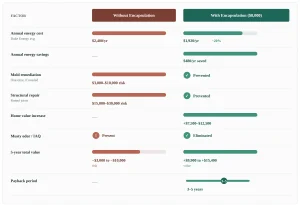
When It’s NOT Worth It
- New construction with builder-installed encapsulation: already done, verify quality
- Slab-on-grade homes: no crawl space to encapsulate
- Budget under $3,000: vapor barrier only is better than nothing, plan for future upgrade
- Home being demolished within 2 years: ROI too short
Does encapsulation stop mold in Greenville crawl spaces?
Yes — encapsulation with a commercial dehumidifier maintains 45–55% relative humidity, well below the 60% threshold where mold grows. Mold needs three things to thrive: moisture (60%+ RH), food source (wood, paper, insulation), and time (24–48 hours at the right conditions). Encapsulation eliminates the moisture leg of the mold triangle. The EPA recommends maintaining indoor relative humidity below 50% to prevent mold growth. In Greenville’s 80%+ summer humidity, an unsealed vented crawl space naturally sits at 70–85% RH — a mold paradise. After encapsulation with dehumidifier, the same crawl space maintains 45–55% RH year-round, making mold growth biologically impossible.
The Mold-RH Connection in NC Climate
| RH Level | Mold Risk | Greenville Summer (Unencapsulated) | Greenville Summer (Encapsulated) |
|---|---|---|---|
| Below 45% | None | Rare (winter only) | Maintained by dehumidifier |
| 45–55% | None (EPA safe zone) | Unreachable without dehumidifier | Target range |
| 55–60% | Low risk | Occasional dry days | Exceeds target — dehumidifier cycles |
| 60–70% | Moderate risk | Common spring/fall | N/A — sealed system |
| 70%+ | High risk (mold grows in 24-48 hrs) | Typical summer | N/A — sealed system |
What’s the best vapor barrier thickness for Pitt County (6/10/20 mil)?
20-mil reinforced polyethylene is the standard for Greenville homes because it lasts 20+ years in Piedmont clay soil, resists punctures from rocks and roots, and carries a 25-year warranty. Six-mil barriers are builder-grade and typically fail in 2–5 years in Cecil clay because the soil’s high clay content creates sharp aggregate that tears thin plastic. Ten-mil barriers last 10–15 years but still puncture under foot traffic during maintenance. The cost difference between 6-mil and 20-mil is only $1,500–$3,000 on a typical 1,500 sq ft crawl space — but the 20-mil lasts 4x longer and comes with a transferable warranty. W.J. Smith installs only 20-mil reinforced barriers as standard, not as an upsell.
Mil Thickness Comparison Table
| Mil | Thickness | Lifespan in NC Clay | Puncture Resistance | Cost per sq ft | Greenville Recommendation |
|---|---|---|---|---|---|
| 6-mil | 0.006″ | 2–5 years | Low (tears on rocks) | $1.00–$1.50 | Not recommended |
| 10-mil | 0.010″ | 10–15 years | Moderate | $1.50–$2.50 | Budget option only |
| 20-mil | 0.020″ | 20+ years | High (reinforced) | $2.50–$4.00 | Standard for Greenville |
Do you offer warranties on encapsulation in Greenville?
Yes , W.J. Smith provides a 25-year barrier warranty, 10-year labor warranty, and all terms are fully transferable to the next homeowner. The 25-year barrier warranty covers material defects and degradation, while the 10-year labor warranty covers installation workmanship including seam integrity, vent sealing, and dehumidifier setup. Transferability means if you sell your Greenville home, the warranty transfers to the buyer at no cost — a selling point that increases home value. National franchises like Tarheel Basement Systems often charge extra for transferable warranties or limit them to 10 years. W.J. Smith includes transferability as standard because we believe the work should outlast our relationship with you.
Warranty Comparison Table
| Component | Warranty Period | Transferable | Conditions |
|---|---|---|---|
| 20-mil vapor barrier | 25 years | Yes, free | Material defects + degradation |
| Labor & installation | 10 years | Yes, free | Seam separation, vent seal failure |
| Commercial dehumidifier | 5 years (manufacturer) | No | Manufacturer defects only |
| Sump pump (primary) | 5 years | No | Manufacturer defects |
| Battery backup sump | 3 years | No | Manufacturer defects |
| Mold remediation | 5 years | No | Mold recurrence in treated area |
Will encapsulation lower my energy bills in NC humidity?
Yes — Duke Energy NC data shows 15–25% HVAC savings after encapsulation in Eastern NC homes. The mechanism is the stack effect: in an unsealed crawl space, hot humid air enters through vents, rises through floorboards, and forces your air conditioner to work harder removing both heat and moisture from your living space. Encapsulation seals this air path, meaning your HVAC only conditions the air inside your home, not the 80% humidity air from below. A typical Greenville homeowner with a $200/month Duke Energy bill saves $30–$50/month after encapsulation — $360–$600/year. Over the 25-year warranty period, that is $9,000–$15,000 in energy savings alone, more than the cost of encapsulation.
Energy Savings Mechanism
- Before encapsulation: 80% RH crawl space air → rises through floor joists → enters living space → AC must remove heat AND dehumidify → high energy consumption
- After encapsulation: Sealed 45–55% RH crawl space → no air exchange with living space → AC only cools, not dehumidifies → 15–25% less energy used
- Additional savings: Ductwork in encapsulated crawl spaces loses less conditioned air (ducts in vented crawl spaces can lose 20–30% of conditioned air)
When crawl space encapsulation is not worth it
Encapsulation is not worth it for homes built on a slab-on-grade foundation, because there is no crawl space to treat. It is also a weaker investment for a dry, well-graded, recently built crawl space that already holds under 60% RH year-round, where a vapor barrier or simple drainage fix may be enough. A free inspection with humidity readings shows which side of that line your Greenville home falls on.
Related reading: crawl space encapsulation in Greenville NC is the full service page, crawl space encapsulation cost in NC breaks down pricing by city, and musty crawl space smell covers the warning signs.
What areas near Greenville do you encapsulate crawl spaces?
We encapsulate crawl spaces in Greenville, Winterville, Farmville, Ayden, Bethel, and all of Pitt County plus Eastern NC within a 2-hour drive of Greenville. W.J. Smith is based at 1035 Director Ct Unit B, Greenville, NC 27858 and provides free inspections throughout Pitt County. We also serve adjacent counties including Beaufort (Washington, NC), Lenoir (Kinston), Craven (New Bern), and Wilson (Wilson, NC) for larger projects. Free inspections are available within Pitt County; projects outside Pitt County may require a travel fee for the initial inspection, which is credited toward your project cost if you proceed.
Service Area
| City | County | Distance from Greenville | Free Inspection |
|---|---|---|---|
| Greenville | Pitt | — | Yes |
| Winterville | Pitt | 6 mi | Yes |
| Farmville | Pitt | 12 mi | Yes |
| Ayden | Pitt | 10 mi | Yes |
| Bethel | Pitt | 14 mi | Yes |
| Washington | Beaufort | 25 mi | Yes |
| Kinston | Lenoir | 42 mi | Yes |
| New Bern | Craven | 55 mi | Yes (project minimum applies) |
—
Our Crawl Space Encapsulation Process in Greenville, NC
- Firstly: We conduct a free 60–90 minute crawl space inspection including digital moisture readings, structural assessment, and photo documentation of all issues.
- Secondly: We deliver a written report within 48 hours with findings, recommended solutions, transparent pricing, and financing options through Watercress Financial.
- Thirdly: Upon approval, we schedule installation and order materials including 20-mil reinforced polyethylene barrier, commercial dehumidifier sized for your crawl space, and any structural repair materials needed.
- Fourthly: Our crew removes existing debris, old vapor barrier, and standing water, then treats any visible mold with EPA-registered antimicrobial solution.
- Fifthly: We install the 20-mil barrier across the floor, extend it 12 inches up the foundation walls, seal all seams with proprietary tape, and seal all vents and penetration points.
- Sixthly: We install the commercial dehumidifier with condensate drainage, wire it to a dedicated circuit, and set the target RH to 50%.
- Finally: We conduct a post-installation inspection, verify RH levels, provide warranty documentation, and schedule a 6-month follow-up to confirm system performance.
Why Choose W.J. Smith Construction for Encapsulation in Greenville?
- Local family-owned, not a franchise: No franchise fees means 20–30% lower pricing than Tarheel Basement Systems without cutting quality.
- 20-mil barrier standard, not an upsell: National franchises charge extra for what we include at baseline.
- 80 Google reviews at 4.9/5.0: Real Greenville homeowners, not paid testimonials.
- BuildZoom score 104: Top 9% of 101,103 North Carolina licensed contractors.
- Greenville-Pitt County Chamber of Commerce member: Invested in this community.
- Free 48-hour written reports: No high-pressure sales and no “today only” pricing games.
- Transferable 25-year warranty: Included standard and increases your home resale value.
- Watercress Financial financing: Terms up to 15 years, soft pull, no prepayment penalties.
Frequently Asked Questions
How much does crawl space encapsulation cost in Greenville, NC?
Complete encapsulation in Greenville costs $5,000–$15,000 depending on crawl space size, vapor barrier thickness, and whether a dehumidifier is included. W.J. Smith provides free inspections and transparent written estimates.
Is crawl space encapsulation worth it for Greenville homes?
Yes. For Greenville’s 51 inches of annual rainfall and 80%+ summer humidity, encapsulation prevents mold, reduces energy bills 15–25%, and protects your foundation from Piedmont clay soil expansion.
What’s the difference between encapsulation and vapor barrier?
A vapor barrier only covers the crawl space floor. Encapsulation seals the floor AND walls, seals all vents and gaps, and adds a dehumidifier. It’s a complete moisture-control system.
How long does encapsulation take in Greenville?
Most encapsulations take 2–3 days. Structural repairs or mold remediation add 1–2 days. W.J. Smith provides a timeline in your written proposal.
Does encapsulation stop mold in Greenville crawl spaces?
Yes. Encapsulation with a dehumidifier maintains 45–55% humidity, below the 60% threshold where mold grows. This is critical in Greenville’s humid climate.
What vapor barrier thickness for Pitt County?
W.J. Smith recommends 20-mil reinforced polyethylene for Greenville homes. It lasts 20+ years in Piedmont clay soil. Six-mil barriers often fail in 2–5 years.
Will encapsulation lower my energy bills?
Yes. Duke Energy NC data shows 15–25% HVAC savings after encapsulation in Eastern NC homes by reducing stack effect and humidity load.
Do you offer warranties on encapsulation?
Yes. 25-year barrier warranty, 10-year labor warranty, fully transferable to the next homeowner. All terms are in your written contract.
Can I encapsulate my crawl space myself?
DIY encapsulation risks improper sealing, inadequate dehumidifier sizing, and missed structural issues. NC requires licensed contractors for structural work. W.J. Smith provides free inspections to assess your specific needs.
What areas near Greenville do you serve?
We encapsulate crawl spaces in Greenville, Winterville, Farmville, Ayden, Bethel, and all of Pitt County plus Eastern NC. Free inspections within 2 hours of Greenville.
e.
Ready to Protect Your Greenville Home’s Crawl Space?
Call 252-304-3012 or Email admin@wjsmithconstruction.com
Free inspection • Written report in 48 hours • Transparent pricing • 25-year transferable warranty • Financing available through Watercress Financial